Icelandic, Lesson Ten
I'm about fifty thousand words into my second novel. The main character is a golden boy southerner who grows up in a tight-knit Catholic household and plays soccer all his life. I went from knowing very little about soccer to knowing all the positions on the field. Some of them have beautiful, elegant names. Winger, second striker. My guy, Todd, is a box-to-box midfielder (also called a wide midfielder). He chose the position that covers the most ground on the pitch because he loves to run. If you'd asked me what "the pitch" was about a month ago, I wouldn't have been able to tell you.
I've taken this to its logical extreme. Next month I'll be attending the England / Panama World Cup game in New York City. Todd would root for England. So will I. I'm doing other things to get to know Todd: Bourbon tastings, visits to Lexington, weekly mass.
The novel in the hands of my agent has an Icelandic main character. I didn't take Icelandic lessons while I was writing the book. I wrote the original draft in a month and a half, and it wasn't until I started to take it seriously--and it started to take ME seriously--that I realized I'd need to excavate the language.
The original idea was to work from apps and pray Google Translate knew the rest. But I wrote something that made me curious.
"He didn’t like wait. Wait was staring at a watch for fifteen minutes.
The right word was in his closet.
Bíddu.
It held bide. Abide. Remain. Stay."
I liked the idea of a word holding time and space inside of it. Apps weren't enough for me. I didn't want to be a tourist, I wanted to be a scholar. So I purchased 3X5 cards, started memorizing conjugations, and took lessons.
I've taken a total of ten lessons, most of them with the same instructor. Every lesson, I learn something new about the language that is actually philosophical--that is revealing of what it means to be Icelandic, the same way Latin-American Spanish lessons reveal something about us. We're casual, practical, we don't like hidden letters: no sneaky g's, no shy k's.
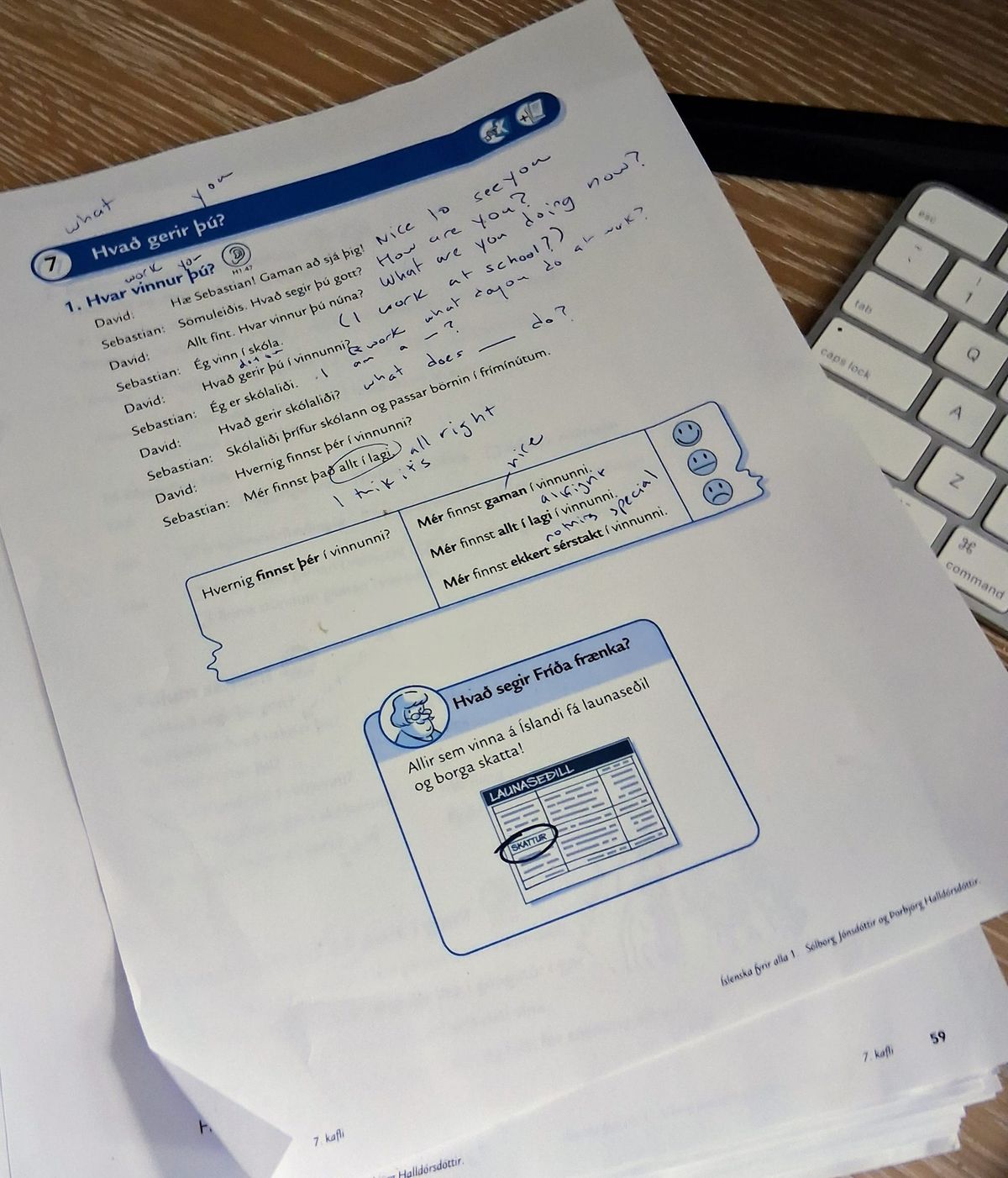
Today's lesson revealed the following philosophical truth: the word for aunt is frænku and the word for uncle is frændi. But that is also the word for cousin. It is the word for second and third cousins. Great aunts and uncles. There is a whole family tree full of interchangeable frænkus and frændis.
My teacher gave the following explanation: We don't judge ourselves by our title or purpose. We judge ourselves by who we are.
"So I can't call you Kennari, (teacher) then?"
"No no. No. That would be a big no."
No one is teacher or great-uncle or instructor or leader. Your name has to stand for all of it.